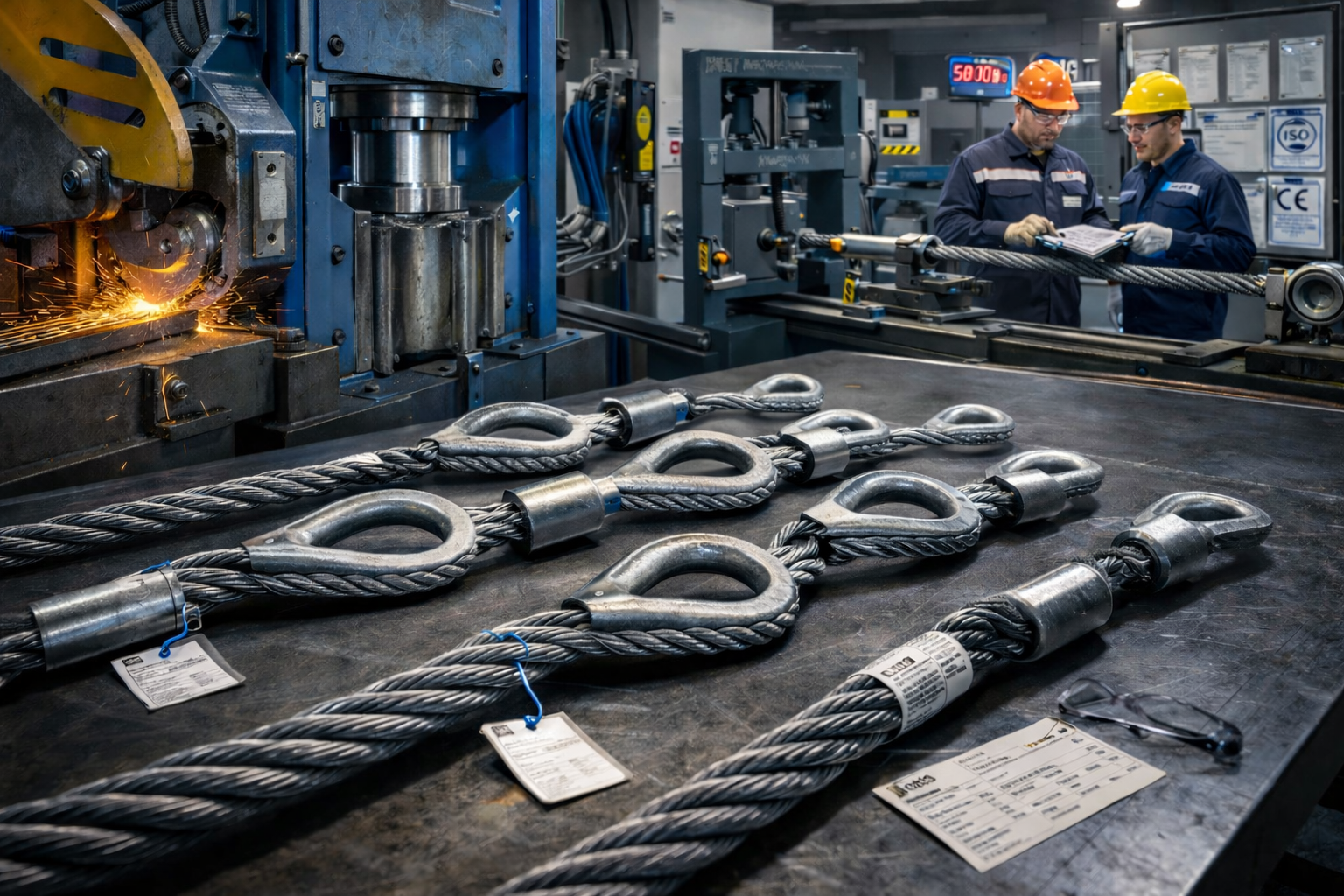
Wire rope slings are not just another product line. They are a safety-critical lifting component used in factories, ports, construction sites, refineries, mines, and logistics yards. That is why sling manufacturing is judged on discipline, traceability, and documentation as much as it is judged on strength.
Many sling units start with strong workmanship but struggle with consistency when orders grow, shift teams change, or customer audits become stricter. The biggest problems are usually not with the rope itself. They are with process control, proof load records, tagging, and certification readiness.
This guide explains sling manufacturing in a practical, step-by-step way, including cutting, swaging, proof load testing, and certifications. It is written for wire rope and sling manufacturers who want to improve quality, reduce rework, and build customer confidence.
For more steel and wire rope industry resources, you can explore SteelExperts.in.
Understanding a Wire Rope Sling
A wire rope sling is an assembly made from wire rope with end fittings designed to lift loads safely. Common sling types include:
- Single leg sling
- Two leg sling
- Three leg sling
- Four leg sling
- Endless sling
- Grommet sling
- Soft eye and hard eye variants
Each sling is defined by:
- Rope diameter and construction
- Sling length and type
- End terminations such as ferrule, socket, thimble, hook, or master link
- Rated capacity, usually expressed as WLL
- Safety factor as required by standard or customer
Because slings are used for lifting, customers expect consistent manufacturing and reliable certificates.
Why Process Discipline Matters in Sling Manufacturing
Sling manufacturing looks simple from outside. Cut rope, add fitting, swage, test, tag, dispatch. But real quality depends on details:
- Correct cut length without strand disturbance
- Correct ferrule selection and pressing sequence
- Correct eye formation and thimble seating
- Correct assembly matching to rope construction
- Correct proof load and recordkeeping
- Correct tagging and identification
When these details are not controlled, plants face issues such as:
- Failed proof load tests
- Premature rope damage at the eye
- Wrong length deliveries
- Missing traceability during customer audits
- Dispute over WLL marking
- Delays in dispatch due to incomplete certificates
A structured system and workflow reduces these risks significantly.
Sling Manufacturing Flow Overview
A typical sling manufacturing flow includes:
- Order and specification confirmation
- Material issuance with traceability
- Cutting and end preparation
- Eye formation and fitting selection
- Swaging or termination process
- Inspection and proof load testing
- Tagging, identification, and certification
- Packing and dispatch
A strong factory controls each step with clear records.
To understand how production, quality, and traceability workflows can be structured digitally, you can explore SteelExperts ERP Modules.
Step 1: Confirm Customer Requirements Before Production
What to confirm
Before cutting any rope, confirm:
- Sling type and configuration (single, double, endless, multi-leg)
- Rope diameter and construction
- End fittings required
- Finished sling length and tolerance
- WLL marking requirements
- Proof load requirement and test method
- Certification format required (standard, project, third-party)
- Packaging and tagging format
Why it matters
Most sling rework happens because of missing clarity at the order stage. If the job card or instruction does not match customer needs, the entire assembly becomes waste.
A digital job card method reduces confusion. If you are planning structured job control, you may find this ERP-related blog useful: Job Cards in Steel Plants: What Good Looks Like (Digital vs Manual).
Step 2: Material Issuance With Traceability
What to control
Sling units often receive rope from internal rope production or from stock. Either way, issuance must capture identity:
- Rope batch number
- Heat and coil information where applicable
- Diameter and construction
- Grade and coating type
- Issued length and weight
- Job card reference
Why it matters
If the rope identity is not recorded, certification becomes weak. It also becomes hard to manage complaints later.
For shop-floor control thinking around FIFO and traceability, you may also refer to: Material Issuance and Return: Prevent Material Missing with FIFO + Traceability.
Step 3: Cutting Process
Cutting is where sling quality can silently get damaged if handled incorrectly.
Cutting methods commonly used
- Mechanical cutting machine
- Abrasive cutting wheel
- Hydraulic shear
- Cold cutting techniques depending on size and requirement
Good practices for cutting
- Confirm cut length with allowance for eye formation
- Prevent unlaying by binding or seizing before cut
- Keep cut end clean and controlled
- Avoid crushing strands during handling
- Maintain consistent length checking method
Common mistakes
- Cutting without seizing which causes strand opening
- Length measurement errors due to wrong reference points
- Mixing cut pieces between multiple orders
A simple cut tag with job number and piece ID reduces mix-ups significantly.
Step 4: Eye Formation and Fittings Selection
Selecting the right thimble and ferrule
The eye assembly depends on correct fitting selection:
- Thimble size must match rope diameter
- Ferrule type must match rope construction and design
- Hooks and master links must match WLL requirement
Eye formation discipline
- Maintain consistent eye size
- Ensure thimble is properly seated
- Ensure correct rope tail length inside the ferrule
- Check that the rope does not cross incorrectly inside the eye
These details influence load distribution and sling life.
Step 5: Swaging and Termination
Swaging is the heart of most rope sling manufacturing.
What swaging must achieve
- Secure termination without slipping
- Correct compression as per fitting requirement
- Consistent shape and finish
- No sharp edges that damage the rope
- Correct alignment of the eye
What to control during swaging
- Press settings and die selection
- Number of presses and sequence
- Ferrule batch and type
- Operator confirmation checks
Inspection after swaging
After swaging, check:
- Ferrule dimensions
- Surface cracks or deformation
- Rope tail visibility as required
- Symmetry of the eye
- Hook or fitting alignment
If your process data is recorded consistently, audits become easier and repeat orders become smoother.
Step 6: Proof Load Testing
Proof load testing is a controlled load test to confirm sling assembly integrity. It is not meant to break the sling. It is meant to validate workmanship and assembly correctness.
What to capture in proof load test record
- Sling ID and job number
- Rope diameter and construction
- End fittings used
- Proof load value applied
- Time held at proof load
- Test rig ID and calibration reference
- Inspector name and date
- Pass or fail result
- Observations and corrective action if failed
Practical tips
- Ensure test machine calibration is valid
- Standardize test format
- Ensure sling length and configuration match test setup
- Record result immediately, not later
Proof load records are often the most checked documents in customer audits.
For quality documentation structure, this compliance-related checklist may help: Quality Documentation Checklist for Wire, Strand, Rope, and Sling Manufacturers.
Step 7: Tagging and Identification
If a sling is not tagged properly, it creates risk for the end user and problems for the manufacturer.
What a sling tag should include
- Sling ID or serial number
- Rope diameter and construction
- Sling length
- WLL
- Manufacturer name
- Traceability reference
- Standard reference if applicable
- Month and year of manufacturing
Why tagging matters
Tagging is not only branding. It is safety information. It also connects the physical sling to its test certificate.
Step 8: Certificates and Compliance
Certificates are not a final paperwork activity. They are the product identity record.
Typical certificate contents
- Customer name and purchase reference
- Sling ID and description
- Rope diameter, construction, grade
- Fitting details
- Proof load value and test result
- Inspection confirmation
- Standard reference if applicable
- Traceability references
- Authorized signature and date
Third-party inspection
Some customers require third-party inspection or project approvals. In those cases:
- Keep inspector observations linked to sling ID
- Attach calibration evidence if requested
- Maintain revision control for certificate formats
If your plant is building export readiness, documentation discipline becomes a key advantage. You may find this export-focused guide helpful: Export Readiness Checklist for Wire and Rope Manufacturers.
How ERP Helps Sling Manufacturers
Many sling units run on registers and Excel. That works until order volume increases and customer audits become strict.
A steel-specific ERP helps sling manufacturing by connecting:
- Job cards and production planning
- Material issuance with traceability
- WIP tracking of sling assemblies
- Proof load test record storage
- Certificate generation linked to sling ID
- Dispatch and packing records
- Complaint investigation with full history
To see how SteelExperts covers production, quality, traceability, and reporting modules, visit: SteelExperts ERP Modules.
To understand our industry focus, you can also visit: About SteelExperts.
External Reference for Lifting Safety Context
For broader guidance related to lifting safety, training, and industry best practices, organizations like OSHA provide safety guidance that helps reinforce why slings are treated as safety-critical products: OSHA.
Frequently Asked Questions
What is the biggest quality risk in sling manufacturing?
Incorrect termination and weak documentation. Even a strong sling can become a liability if proof load testing and tagging records are missing or inconsistent.
Do all slings need proof load testing?
It depends on customer requirement and the standard you follow. Many industrial customers insist on proof load tests for every sling or for each batch. The safest approach is to align with customer and standard expectations and document clearly.
How do we avoid wrong length slings?
Standardize measurement reference points, add length allowances clearly in job cards, and tag cut pieces immediately with job reference and piece ID.
Why do customers insist on certificates?
Because slings are used for lifting. Certificates provide evidence of test, inspection, and traceability. Without certificates, trust reduces and audits become difficult.
How can SteelExperts ERP support sling manufacturing units?
SteelExperts ERP helps sling manufacturers manage job cards, material issuance, batch traceability, proof load records, certificate generation, and dispatch workflows in one system. You can explore the modules here: SteelExperts ERP Modules.
Conclusion
Sling manufacturing is a disciplined process. Cutting and swaging require workmanship, but proof load testing, tagging, and certifications build trust and compliance.
Plants that standardize job instructions, maintain traceability, and capture proof load data cleanly can scale confidently, reduce rework, and handle audits without stress.
For more steel wire and rope industry guidance and ERP insights, visit SteelExperts.in.