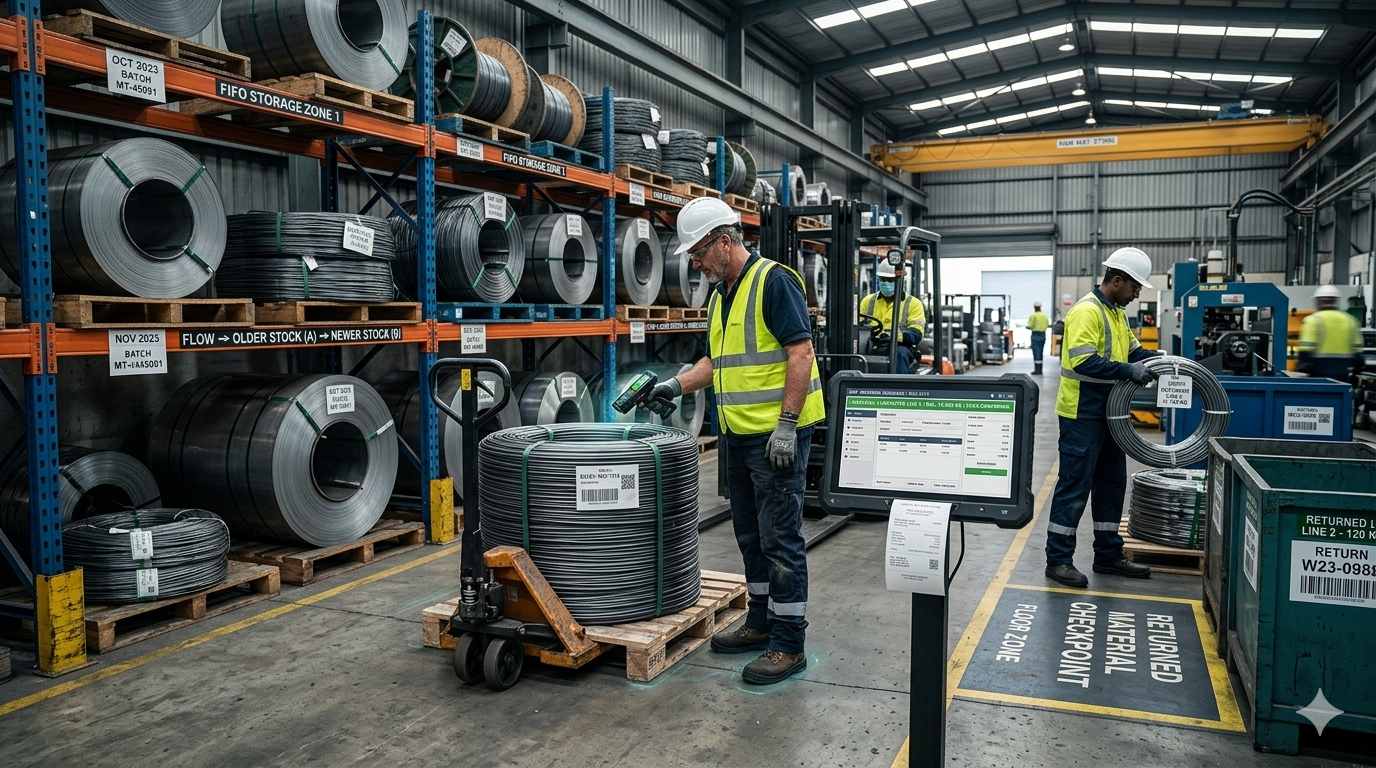
In steel manufacturing, “material missing” is one of the most common daily problems discussed in production meetings. System stock looks correct, but coils are not traceable. Stores says material is issued, but production says it was not received. A partial coil is returned to the yard, but the return entry never happens. Scrap is generated, but weight is not captured properly. Over time, this creates confusion, delays, and inventory mismatch.
In this blog, material missing means material that becomes untraceable due to process gaps such as wrong issuance, missing return entries, mixed heats, uncontrolled scrap handling, and poor FIFO discipline. Many plants also call this material leakage, but “material missing” is easier for most teams to understand and act on.
This guide explains a practical way to tighten material issuance and return using two strong controls: FIFO discipline and traceability. The focus is shop-floor execution for steel rod, wire, strand, LRPC, wire rope, and sling manufacturers.
For more steel-focused production and ERP insights, visit SteelExperts.in.
Why Material Goes Missing in Steel Plants
Before fixing the problem, it helps to recognize the real reasons behind it.
1. Issuance happens in kg, not by coil or heat
Many plants issue rod or wire as a quantity entry. The coil identity does not travel with the issue record. Later, when a quality complaint comes or stock looks short, nobody can confidently answer:
- Which heat was used for this order
- Which coil went to which machine
- Which reel became part of which batch
When identity is missing, traceability becomes weak and material goes missing in practical terms.
2. Returns are treated casually
Returns are the biggest source of mismatch. Some common examples:
- Leftover coil goes back but return is not posted
- Partial reels are parked in a bay and forgotten
- Rejected material is not separated and gets reused
- Scrap is removed but not weighed
The system stock becomes higher than physical stock, and the plant starts losing trust in inventory numbers.
3. FIFO is assumed, not enforced
Teams often believe FIFO is followed because coils are stored in a sequence. In reality, FIFO breaks due to:
- Urgent orders
- Crane convenience
- Operator habits
- Mixing of multiple grades and sizes in the same lane
Once FIFO breaks frequently, old coils age, rust risk increases, and mixing problems become more common.
4. Multi-stage production increases confusion
Wire and rope plants are multi-stage by nature:
- Rod to drawing
- Drawing to intermediate reels
- Reels to stranding
- Stranding to closing
- Rope to sling assembly
If issuance and return are not controlled at every stage, “material missing” becomes a daily headache.
What FIFO + Traceability Means in Daily Operations
FIFO means first in, first out. But in steel plants, FIFO is not only about the oldest receipt date. It must respect:
- Heat number and grade
- Size and diameter
- Coating type where applicable
- Customer or export requirements
- Hold or quarantine status
Traceability means you can connect material from start to finish:
- From heat and coil to finished goods
- From finished goods back to heat, coil, reel, and process history
When FIFO and traceability work together, issuance becomes disciplined and returns become controlled.
To understand how a steel-specific ERP connects inventory, production, and traceability, you can review SteelExperts ERP Modules.
Shop-Floor Strategy to Prevent Material Missing
1. Start with Strong Receipt and Identity Control
What to capture during inward
Every heat and coil should be captured with:
- Heat number
- Supplier and mill certificate reference
- Grade and diameter
- Coil weight
- Inward date and inward number
- Location and lane details
- Unique coil ID tag
Why this prevents material missing
If you do not lock identity at inward, everything later becomes weak. Issue, return, QC, and traceability all depend on good inward discipline.
2. Store Material in FIFO-Friendly Locations
FIFO becomes simple when yard layout supports it.
Practical storage rules
- Separate lanes by grade where possible
- Maintain heat separation if required by your quality process
- Mark receipt sequence visually
- Keep a quarantine area for hold and rejection material
- Enforce a rule that location must be updated when a coil moves
A simple discipline rule that works
No coil movement should happen without updating the location. Even basic location discipline reduces missing material situations.
3. Issue Material as a Specific Coil, Not Only as Quantity
What issuance should include
Instead of issuing only weight, issue:
- Coil ID and heat number
- Issued weight
- Destination machine, bay, or line
- Production order or job card reference
- Date and time
- Issuer name
Why this works
Coil-specific issuance makes it possible to:
- Enforce FIFO correctly
- Link consumption to job and batch
- Match returns to original issue
- Calculate yield and scrap more accurately
- Reduce disputes between stores and production
4. Enforce FIFO with Controlled Exceptions
FIFO should be the default, but exceptions are normal. The key is to make exceptions controlled and visible.
FIFO rules that work well in steel plants
- System suggests the oldest eligible coil of correct grade and size
- Coils on hold cannot be issued
- Override allowed only with a selected reason code
- Aging alerts highlight coils that are staying too long
Examples of valid override reasons
- Export customer requires a specific heat
- Older coil is under lab hold
- Older coil has rust or damage
- Urgent dispatch needs matching chemistry for repeatability
This method keeps FIFO strong without blocking real-world urgency.
5. Capture Consumption Balance at Each Stage
In multi-stage plants, the issue and return logic must exist at every stage, not only at RM stores.
What to capture per stage
- Input coil or reel IDs
- Output reel IDs
- Output weight
- Scrap weight
- Reason code for major scrap
- Machine and operator reference
Stage-wise capture helps you catch missing material early. If you wait for month-end reconciliation, it becomes much harder to identify where the gap happened.
6. Treat Returns as Proper Transactions
Returns should not be a casual physical movement. They must be recorded like an inward.
What counts as a return
- Partial coils after job completion
- Leftover reels due to plan change
- Material returned after quality rejection
- Unused issued material
What to capture in return entry
- Original issue reference number
- Returned coil or reel ID
- Returned weight
- Condition status such as OK, hold, damaged, rework
- Return location
- Reason for return
When returns are linked to the original issue, missing material reduces sharply.
7. Record Scrap and Rejections Cleanly
Scrap is the most common hidden reason for stock mismatch.
Best practice
- Weigh scrap at source where possible
- Record scrap by job and machine
- Classify scrap reasons such as setup scrap, wire breaks, trimming, quality rejection
- Move scrap to a defined scrap location with entry
This makes yield reports meaningful and also helps identify machine and process issues.
8. Use Simple Physical Controls That Support Digital Discipline
Even the best ERP will fail if physical discipline is weak.
Practical controls that work
- Coil and reel tags with large readable IDs
- Color-based status tags: OK, hold, reject
- Fixed parking zones for WIP reels
- Separate lanes for returns waiting for QA decision
- A simple rule: no tag means no move
If you want to understand how SteelExperts approaches practical shop-floor workflows, visit About SteelExperts.
How a Steel-Specific ERP Helps Reduce Material Missing
A generic ERP often tracks inventory as bulk quantities. Steel plants need identity-based control using heats, coils, and reels.
A steel-specific ERP supports:
- Coil-wise and heat-wise issuance
- FIFO suggestion based on eligible stock
- Return linkage to original issue
- WIP tracking by reel across stages
- Scrap tracking and yield visibility
- Traceability for audits and customer confidence
Explore how inventory, production, quality, and planning connect here: SteelExperts ERP Modules.
Practical Checklist for Your Plant
Issuance checklist
- Do we issue by coil ID and heat number
- Do we record destination machine and job reference
- Can we trace each issue to a finished batch
FIFO checklist
- Do we follow FIFO by default
- Do we record override reasons
- Do we track coil aging and hold status
Return checklist
- Do we return partial coils with proper weight
- Do returns have condition status
- Is returned material stored in a controlled location before reuse
Scrap checklist
- Is scrap weighed and recorded
- Do we capture scrap reason codes
- Do we reconcile scrap monthly
External Reference for FIFO and Inventory Discipline
For general FIFO and inventory accuracy concepts used in manufacturing supply chains, ASCM is a useful reference: ASCM.
Frequently Asked Questions
Is material missing always theft
No. In most plants, material missing happens due to process gaps such as missing return entries, scrap not recorded, wrong issuance, or mixed identification. Strong process control reduces it quickly.
Do we need barcode or QR scanning to start FIFO and traceability
No. Start with unique coil IDs, strong receipt discipline, and proper issue and return transactions. Scanning can be added later to reduce typing and speed up movement entries.
How do we handle urgent orders if FIFO suggests a different coil
Allow controlled override with a reason code. FIFO is the default, but real manufacturing needs exceptions. The difference is visibility and traceability.
What is the fastest improvement to reduce missing material
Make issuance coil-specific and enforce return entries with weight and condition status. These two steps alone improve inventory confidence.
How does SteelExperts ERP support issuance and return control
SteelExperts ERP is designed for steel rod, wire, strand, LRPC, wire rope, and sling manufacturers. It supports coil-level tracking, FIFO issue logic, return linkage, WIP visibility, and traceability so missing material reduces and inventory accuracy improves. Explore modules here: SteelExperts ERP Modules.
Conclusion
Material issuance and return control is one of the most practical ways to reduce material missing and improve inventory accuracy in steel plants.
The approach is straightforward:
- Lock identity at inward
- Store coils in FIFO-friendly lanes
- Issue by coil and heat, not only by kg
- Enforce FIFO with controlled overrides
- Return material with proper entries and condition status
- Track scrap and rejection properly
- Keep traceability across each production stage
When FIFO and traceability become daily habits, missing material reduces, quality improves, and planning becomes reliable.
For more shop-floor focused steel manufacturing insights, visit SteelExperts.in.