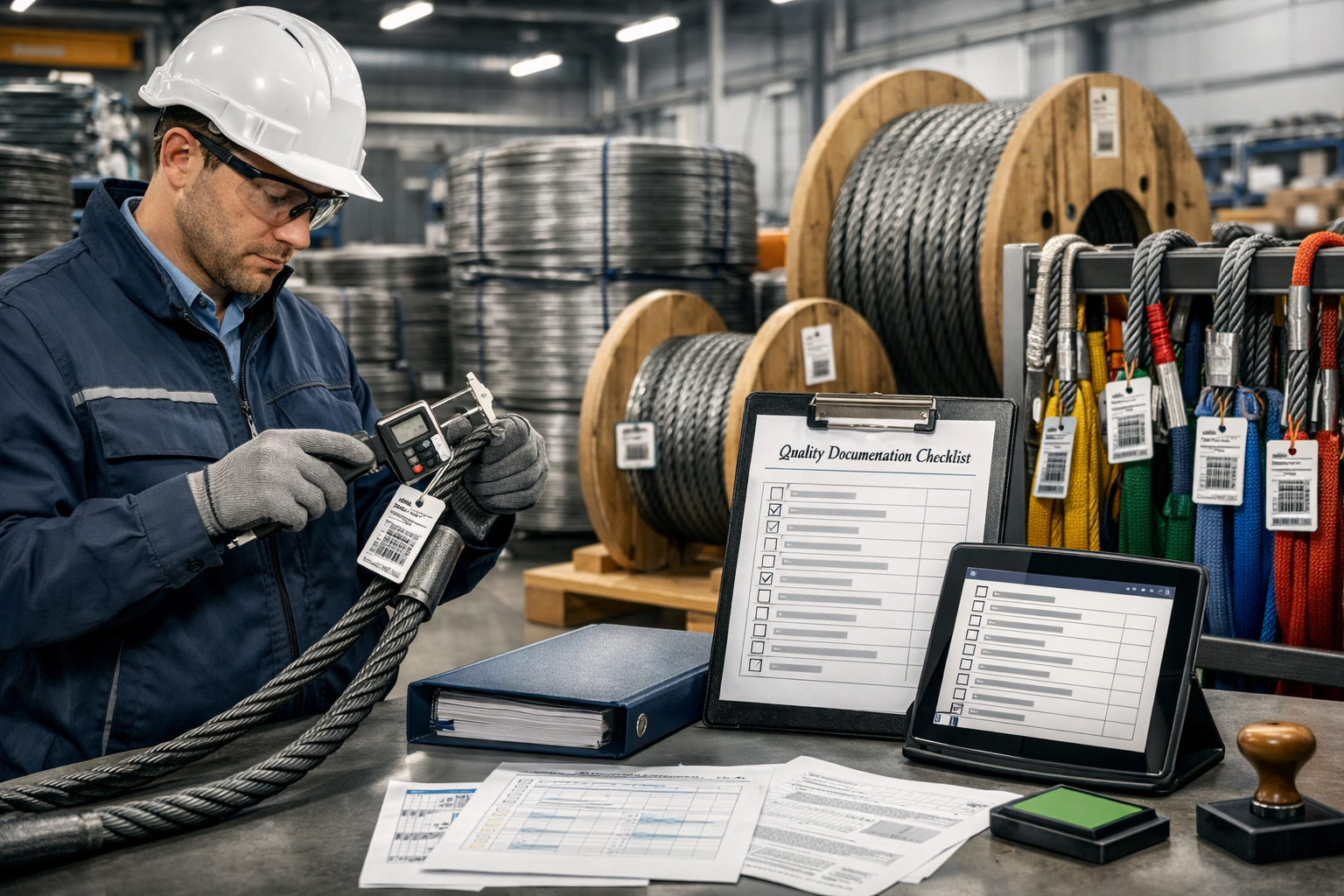
Quality in steel wire, strand, rope and sling manufacturing is not only about testing. It is also about proof. Customers, auditors and third party inspectors all want to see clear evidence that every coil, reel and rope has followed a controlled process.
If documentation is weak or scattered, even a technically good product can face complaints, rejected lots or delayed dispatches.
This article gives a practical quality documentation checklist for manufacturers of steel wire, strand, LRPC, wire rope and slings. You can use it as a reference while strengthening your quality management system and preparing for customer audits or certifications.
For more steel focused ERP and process content, you can explore SteelExperts.in.
Why Quality Documentation Matters in Wire and Rope Manufacturing
Steel wire, strand and rope are often used in safety critical and load bearing applications. Cranes, lifts, construction, bridges and mining all depend on reliable performance. That is why buyers and regulators pay so much attention to:
- Traceability from heat to finished rope or sling
- Mechanical properties and coating thickness
- Process control at each stage
- Non conformity handling and corrective actions
Without a solid quality documentation system, it becomes very difficult to:
- Prove that procedures were followed
- Investigate customer complaints
- Pass audits for new customers or export markets
- Retain approvals for demanding end applications
A steel specific ERP like SteelExperts can help you manage this flow of information as part of daily operations instead of treating documentation as an extra burden. To see how quality, production and traceability modules fit together, you can review SteelExperts ERP Modules.
Core Quality Documents Every Plant Should Control
Below is a structured checklist of the most important document groups for wire, strand, rope and sling manufacturing.
1. Raw Material and Incoming Inspection Documents
For every heat and coil received, your documentation should include:
- Mill test certificates with chemical and mechanical properties
- Internal incoming inspection records
- Heat and coil identification tags and mapping
- Supplier approval status and any special conditions
These documents form the starting point of traceability. They link final products back to the steel source.
2. Process Routing and Work Instructions
Each product family such as wire, strand, rope and slings should have:
- Approved process flow or routing sheets
- Work instructions for drawing, stranding, closing and sling assembly
- Set up parameters or ranges for critical machines
- Special instructions for export or high risk applications
Auditors often ask to see that operators have access to the latest version of these documents near the workplace.
3. In Process and WIP Quality Records
Between raw material and finished product, there are many control points. Your in process documentation should cover:
- Wire drawing in process checks such as diameter and surface condition
- Strand lay length, wire arrangement and compaction checks
- Closing parameters and rope construction verification
- Visual checks at key transitions between processes
A strong practice is to link these records with specific coils, reels or batches, not only with generic dates. If you are exploring reel level control, the case study Case Study: Reducing WIP Confusion with Reel Level Tracking shows how WIP and quality can be tied together at reel level.
4. Final Inspection and Test Certificates
Final quality documentation is what customers see most frequently. It should include:
- Dimensional checks and visual inspection results
- Mechanical test results such as UTS, yield strength and elongation
- Special tests such as torsion, reverse bend or fatigue where applicable
- Coating weight or thickness for galvanized products
- Proof load and break load results for ropes and slings
Based on this information, you generate:
- Test certificates linked with batch, reel or rope numbers
- Certificates of compliance as per relevant standards or customer specifications
5. Traceability and Identification Records
Traceability documentation ensures that you can move in both directions:
- From heat and coil to finished rope or sling
- From a delivered rope back to heat, coil and process history
You should maintain clear links between:
- Heat number and incoming coil
- Coil and drawing reel
- Drawing reels and strand batches
- Strand batches and final rope or sling
If you plan to grow exports, this level of traceability becomes a strong selling point. The article Export Readiness Checklist for Wire and Rope Manufacturers covers how documentation supports export readiness in more detail.
6. Non Conformance, Rework and CAPA Records
No plant is perfect. What matters is how non conformities are handled. Key documents include:
- Non conformity reports with clear description and disposition
- Rework instructions and verification records
- Customer complaint records with investigation details
- Corrective and preventive action (CAPA) reports
Auditors and key customers often focus on this part of the system, as it shows how the plant learns from problems.
7. Calibration and Equipment Qualification
Your test results are only as reliable as your equipment. You need documentation for:
- Calibration certificates for tensile testers, hardness machines and weighing scales
- Verification records for proof load and break load test rigs
- Periodic checks for measuring instruments such as micrometers and vernier calipers
- Equipment qualification records where required by standards
8. Standard and Customer Specific Requirements
Most plants work with a mix of:
- International or national standards
- Customer specific specifications
- Project or application specific requirements
All relevant documents should be:
- Controlled for revision
- Easy to retrieve for reference
- Available in quality and technical departments
Building a Practical Quality Documentation Checklist
To make this checklist usable in your plant, you can organize it around three questions:
Question 1: Can we prove what we received and used
- Do we have mill test certificates and incoming inspection records for all heats
- Can we link each reel or batch to a specific heat and supplier
Question 2: Can we prove what we did at each stage
- Do we have in process records for drawing, stranding and closing
- Do we capture deviations and rework decisions
Question 3: Can we prove what we delivered
- Can we issue test certificates quickly for any delivered batch
- Can we trace complaints back to process and raw material history
If the answer is unclear for any of these, you know where to focus your next improvement.
Digital Backbone: Using ERP for Quality Documentation
Managing all these documents on paper or in isolated spreadsheets quickly becomes difficult. A specialized ERP for steel manufacturers can store:
- Heat and coil information
- Process routing and in process records
- Test results and certificates
- Non conformity and CAPA records
SteelExperts ERP is designed for steel wire, strand, rope and sling environments, so quality documentation is embedded in production and traceability rather than treated as an afterthought.
If you are planning a digital roadmap for your plant, the blog ERP Implementation Plan for Steel Plants: 30 60 90 Day Roadmap offers a practical phased approach.
To understand the mission and focus behind SteelExperts, you can also visit About SteelExperts.
External Reference for Standards and Documentation
For broader understanding of quality and standards in steel and manufacturing, bodies like ISO and industry associations publish guidance on documentation and compliance. As a starting point, you may explore: ISO Standards Catalogue. This can help your quality team align internal practices with international expectations.
Frequently Asked Questions
Is detailed quality documentation only necessary for export customers
No. Even domestic customers increasingly expect clear documents and traceability. Strong documentation reduces disputes, shortens complaint investigations and supports both local and export growth.
Do small and mid sized wire and rope plants really need an ERP for documentation
While it is possible to manage with paper and spreadsheets at small scale, the effort and risk grow quickly. A steel specific ERP helps connect raw material, production, quality and dispatch so documentation becomes a byproduct of normal work instead of an extra layer.
How long should we retain quality records
Retention periods depend on standards, customer contracts and regulatory requirements. Many plants keep core records such as certificates, non conformities and test data for several years to support repeat orders and safety investigations.
What is the most common weakness auditors find in quality documentation
Common issues include missing links between test results and specific reels, incomplete non conformity and CAPA records, and uncontrolled use of outdated specifications on the shop floor.
How does SteelExperts ERP support compliance and standards
SteelExperts ERP is built for steel rod, wire, strand, LRPC, wire rope and sling manufacturers. It helps you maintain heat and reel traceability, store quality records in structured form, generate certificates and connect documentation with production orders. You can explore the module overview here: SteelExperts ERP Modules.
Conclusion
For wire, strand, rope and sling manufacturers, quality documentation is not just paperwork. It is the visible face of your process discipline and a key pillar of customer trust.
By organizing your documents around raw material, process control, final inspection, traceability, non conformities and calibration, and by using a steel specific ERP as the digital backbone, you can make documentation both reliable and manageable.
For more insights, case studies and ERP guidance tailored to steel manufacturers, you can explore SteelExperts.in.