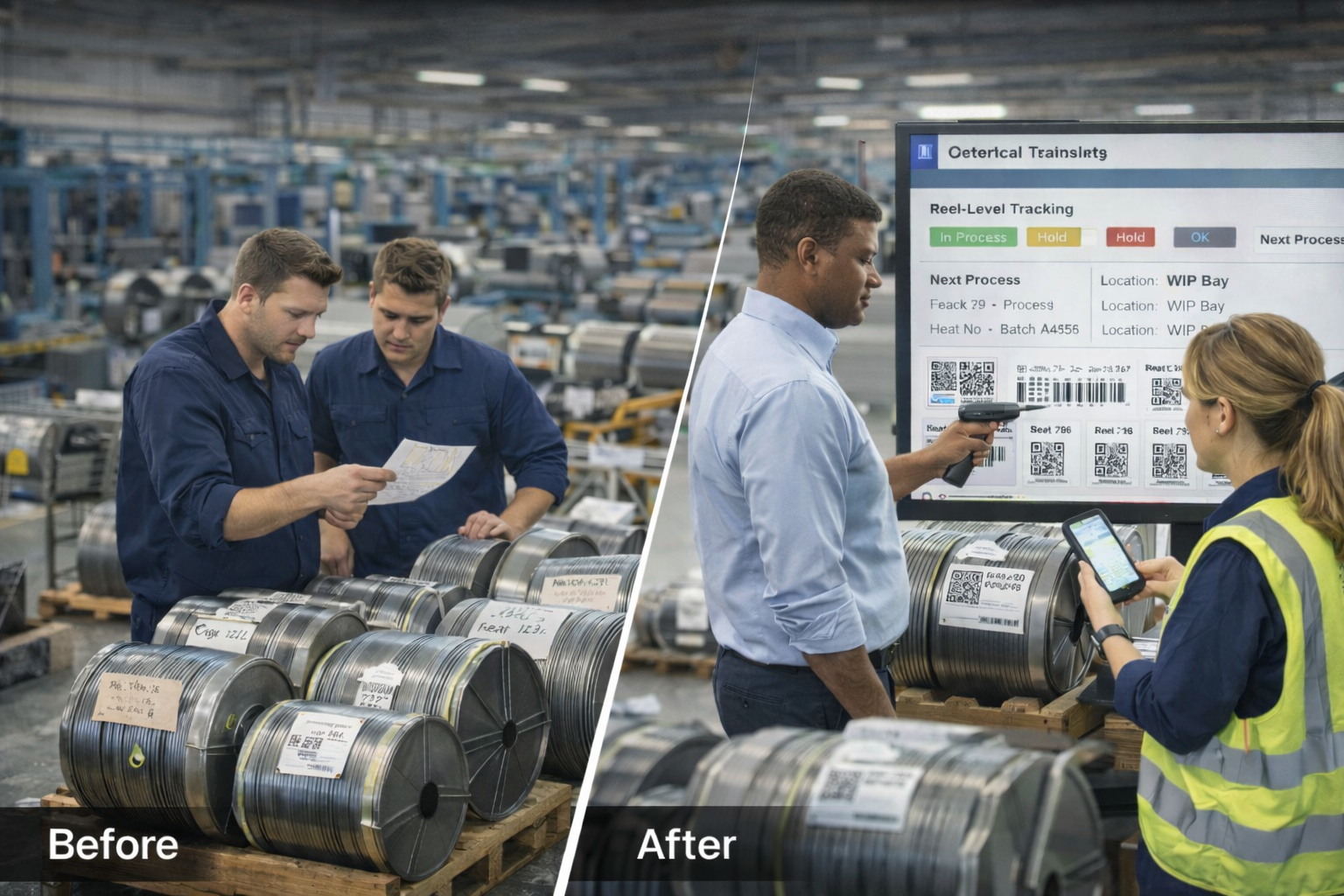
Work in progress is the heartbeat of any steel wire and rope plant. Coils, cut lengths and reels are constantly moving from drawing to stranding, from stranding to closing, and from closing to final inspection. When WIP is not visible, everything starts to feel uncertain.
This case study shows how a mid sized wire and rope manufacturer reduced WIP confusion by introducing reel level tracking with a steel specific ERP. The story will feel familiar if you manufacture steel wire, strand, LRPC, wire rope or slings and struggle daily with questions like “Where is that reel now” and “Do we really have that much WIP”.
For more steel focused digital stories and concepts, you can explore SteelExperts.in.
Company Background
The plant in this case manufactures:
- High carbon steel wires in multiple diameters
- Strands for construction and power applications
- Wire ropes for lifting and crane duty
The factory has:
- Three drawing lines
- Two stranding machines
- Two closing machines
- A separate area for final inspection and packing
Demand was healthy, but daily production meetings often began with confusion about actual WIP and available material.
The Problem: WIP Numbers Without Real Reels
Symptoms on the shop floor
The plant team faced recurring issues:
- Planning showed enough WIP, but reels were not traceable
- Operators walked across bays to hunt for physical reels
- Multiple Excel sheets tried to track coil and reel status
- Production and stores often disagreed on available stock
- Customer urgent orders required manual checking of every bay
From a management view, the ERP showed WIP as a quantity number. On the floor, supervisors thought in physical reels, drums and coils. That gap was the real problem.
Why Traditional ERP Logic Was Not Enough
Quantity based WIP vs reel based reality
The existing ERP was good at basic inventory. It could show:
- Total WIP in kilograms at each stage
- Material by grade and size
- Finished goods stock for dispatch
But it could not answer questions such as:
- Which exact reel is ready for the next process
- Where is reel R12345 physically located
- Which reels belong to a specific sales order
- Which reels are stuck due to quality checks
The result was WIP without confidence. Numbers looked correct in reports, but nobody trusted them completely during planning.
The Solution: Reel Level Tracking with SteelExperts ERP
The company decided to introduce reel level tracking as part of a focused ERP implementation with a steel specific approach.
To see how SteelExperts thinks about modules and shop floor reality, you can review SteelExperts ERP Modules.
Key design decision
Every physical reel, coil or drum would receive:
- A unique reel ID
- A printed tag with QR code and human readable details
- A digital record inside the ERP linked with heat, size, machine and process stage
From that point onward, WIP would be managed as a collection of reels, not just as bulk quantity.
Implementation Journey
Phase 1: Mapping the real material journey
The joint project team walked the shop floor and mapped:
- Where raw material coils enter
- How they move to drawing, intermediate storage and stranding
- How closing and final inspection interact with stores
- Places where reels were usually parked or temporarily stored
This resulted in a clear reel journey:
Raw Coil → Drawing Reel → Intermediate Reel → Stranding Reel → Closing Reel → Finished Reel
Phase 2: Reel ID and QR tag design
Next, the team defined:
- Simple reel ID structure linked with heat and product family
- Tag format with reel ID, size, grade and process stage
- Basic QR code layout for future scanning
Initially, tags were printed from desktop printers in stores and drawing bays. The plant did not invest in expensive hardware at this stage.
Phase 3: ERP configuration and screens
SteelExperts ERP was configured to:
- Create a reel record whenever a coil or reel was produced at drawing
- Track each reel as it moved from drawing to stranding to closing
- Link reels to specific production orders and sales orders
- Show real time WIP as a reel list, not just as a quantity report
Practical, operator friendly screens were deployed in drawing, stranding, closing and final inspection.
Phase 4: Pilot and roll out
The company started with:
- One drawing line
- One stranding machine
- One closing machine
After three weeks of daily use and minor adjustments, reel level tracking was rolled out to all lines.
For a detailed view of how a structured ERP implementation timeline looks in steel plants, you may also read ERP Implementation Plan for Steel Plants: 30 60 90 Day Roadmap.
Results After Three Months
1. Clear WIP visibility
Planning and production now had:
- Exact list of reels at each stage
- Real time status for every reel (in process, waiting, on hold, ready)
- Location wise visibility by bay, machine or storage area
Morning meetings shifted from “Where is that material” to “Which reels will you use for today”.
2. Faster response to urgent orders
When a priority order arrived, planners could:
- Search reels by size, grade and stage
- Reserve specific reels for that order
- Give realistic delivery commitments based on actual WIP
This directly improved customer confidence and reduced last minute scrambling.
3. Reduction in search time and confusion
Supervisors reported:
- Less time spent walking and manually checking reels
- Fewer arguments between production and stores about available material
- Better shift handover clarity
For export customers, the company could now demonstrate reel level traceability, which supported their export readiness journey. You can learn more about that angle in Export Readiness Checklist for Wire and Rope Manufacturers.
4. Better WIP control and working capital discipline
Management now had:
- Clear picture of how much WIP was genuinely useful
- Identification of reels that were stuck or aging
- Ability to reduce excess intermediate WIP
Reel level tracking turned WIP from a vague number into a clear, manageable set of physical units.
How SteelExperts ERP Supports Reel Level Tracking
SteelExperts ERP is designed for steel rod, wire, strand, LRPC, wire rope and sling producers. Reel level tracking in this case was built using features that are already tuned to steel operations, such as:
- Heat and coil wise material control
- Process routing for drawing, stranding and closing
- WIP representation as coils and reels
- QR tag friendly material movement
If you want to see how these pieces connect with planning, quality, maintenance and inventory, you can review SteelExperts ERP Modules.
To understand the story and mission behind the platform, you can also visit About SteelExperts.
External Reference for WIP and Lean Thinking
For general concepts related to WIP control and lean manufacturing, the Lean Enterprise Institute publishes useful articles and case studies on flow, pull systems and WIP limitation: Lean Enterprise Institute Resources. This kind of material can help internal teams connect reel level tracking with broader lean initiatives.
Frequently Asked Questions
Do we need expensive scanners to start reel level tracking
No. In this case, the plant started with printed tags and manual entry of reel IDs into the ERP. QR scanning was added later for speed. The important part is to assign a unique ID and track status consistently.
Can reel level tracking work if we already have an ERP
Yes, if your ERP can represent WIP as discrete units instead of only quantities. Many plants add a steel specific layer, such as SteelExperts ERP, to handle reel, coil and process logic while still integrating with existing systems where needed.
Will reel level tracking slow down operators
During the first week, it may feel like an extra step. Once operators see how it reduces confusion and repeated questions from planning and stores, they usually support it. Good screen design and simple tagging are essential.
Is reel level tracking only useful for wire rope plants
No. It is equally valuable for wire drawing, strand, LRPC and other continuous processes where material moves in discrete packages rather than in loose bulk form.
How does SteelExperts ERP help with WIP confusion
SteelExperts ERP is built for steel manufacturers and shows WIP as coils and reels with status, location and process stage. Planning, production, quality and stores see the same picture, which reduces arguments and improves decisions. You can explore the coverage here: SteelExperts ERP Modules.
Conclusion
Reel level tracking turned this wire and rope plant’s WIP from a confusing number into a clear, shared reality. Planners gained confidence, supervisors saved time and management gained better control of working capital.
You do not need a large and complex program to begin. A focused project with clear reel IDs, practical tags and a steel specific ERP can create visible impact in a few months.
For more case studies, ideas and ERP insights tailored to steel manufacturers, you can explore SteelExperts.in.