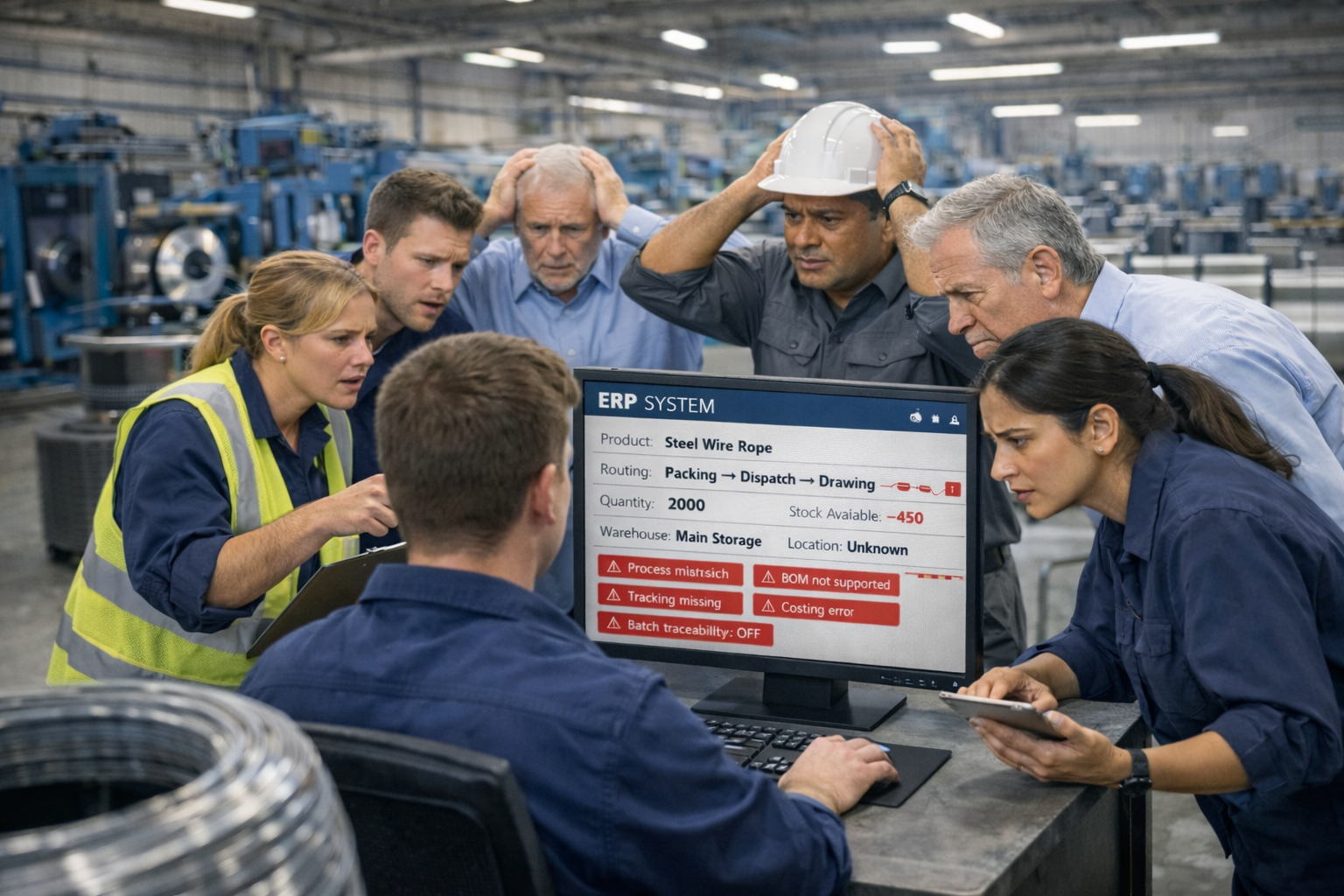
Steel wire and rope manufacturing is one of the most complex production environments in the metal industry. From multi-stage wire drawing and heat treatment to stranding, closing and quality certification, every batch involves precise planning and constant traceability. Many manufacturers start their digital journey with a generic ERP system, only to discover later that it cannot support the unique workflows of this industry. The result is process gaps, wrong planning, poor inventory visibility, delayed dispatches and frequent reporting errors.
This article explains why traditional ERPs struggle in steel wire and rope manufacturing and what manufacturers should look for in an industry-specific solution.
The Reality of Steel Wire and Rope Manufacturing
Unlike standard manufacturing where processes are linear, steel wire and rope production involves continuous changes in diameter, tensile grades, heat numbers and coil movement across multiple stages. Each step affects the next stage, and every mistake impacts the final product.
A generic ERP system cannot understand:
- Multi pass wire drawing
- Heat and patenting cycles
- Multi layer stranding
- Closing and torque balancing
- Rework loops
- Quality testing at multiple checkpoints
- WIP identification by coil or reel
- FIFO or heat wise material allocation
- Batch, bin and location tracking
This is why steel manufacturers often end up using Excel sheets even after purchasing an expensive ERP.
Core Reasons Why Generic ERPs Fail
1. No Support for Multi Stage Wire Drawing
Wire drawing is not a single operation. A rod may pass through ten to twelve dies, each reducing its diameter and changing its mechanical properties. Generic ERPs treat these as simple production steps which means they cannot track pass wise diameter, lubrication and wire break logs, die usage, operator wise efficiency, and heat wise in and out. This leads to incomplete traceability and difficulty in handling customer complaints.
2. Poor Visibility of WIP and Coil Movement
In steel wire and rope manufacturing, WIP is not just another quantity. It moves physically from pickling to patenting, from drawing to stranding, then to closing and final inspection. Most ERPs cannot track WIP by coil, maintain QR based movement, identify the exact location of reels, or provide real time WIP summaries. This frequently results in lost coils, unbalanced planning and delays during dispatch.
3. Inadequate Planning for Steel Manufacturing
Standard ERPs are not built for MPS based monthly delivery planning, MRP linked with heat, coil and reel availability, CRP for machines like wire drawing, stranding and closing, and production routing variations for different types of wire or rope. Planners end up working manually and the ERP becomes just a data entry tool.
4. Inflexible Quality Control Structures
Quality is the backbone of the steel wire and rope industry. Generic ERPs typically support only basic QC tasks which are not enough for processes that require in process QC after each pass, tensile strength and elongation tests, torsion and reverse bend tests, galvanization coating thickness, and final rope inspection with proof load certificates. Without these features, maintaining quality consistency becomes a challenge.
5. No Traceability from Raw Material to Finished Rope
Customers often demand complete traceability from raw material to the final rope. They want to know which heat, coil and production line was used. A generic ERP cannot maintain the link between heat, coil, reel, drawing pass, stranding batch, closing batch and the final product. This makes compliance and certification difficult.
6. Lack of Industry Specific Reporting
Production managers, planners and QA teams need meaningful reports like daily drawing output, stranding performance, rework rate, heat wise consumption, batch wise rejection, and machine downtime. Generic ERPs cannot generate these reports without heavy customization.
What Manufacturers Should Choose Instead
A purpose built ERP designed for steel wire, strand and rope manufacturing solves all these problems from the ground up. At SteelExperts.in, we focus on the real operational needs of wire and rope plants and build industry-first digital systems that match actual shop-floor workflows.
If you are evaluating a specialized solution, explore our ERP modules and industry capabilities here: SteelExperts ERP Modules. This section covers planning, production, quality, inventory traceability, and other critical features built specifically for steel wire, strand and rope manufacturers.
To understand our long-term vision and the industries we serve, you can also visit our company overview page: About Steel Experts.
These modules are designed with real industry logic such as multi stage wire drawing tracking, heat wise RM allocation, QR based WIP movement, MPS, MRP, CRP and full production planning, complete routing and recipe management, QC module with industry standard tests, coil, reel and rope level traceability, and automated certificates and compliance documents. This ensures that the ERP works exactly the way the steel manufacturing process works.
Frequently Asked Questions
Why do most ERPs fail in steel wire and rope factories?
Because standard ERPs are designed for simple manufacturing. Steel wire and rope production requires multi stage processing, coil level traceability and complex planning that generic systems cannot manage.
Can a generic ERP be customized to work for steel manufacturing?
It can be customized but the cost becomes higher than buying a purpose built ERP. Also, future updates and maintenance become very complicated.
What is the biggest challenge in ERP implementation for wire and rope plants?
The biggest challenge is syncing real world coil movement with digital WIP tracking. This requires an ERP built specifically for QR or tag based tracking.
How does SteelExperts ERP solve these industry issues?
SteelExperts includes modules for planning, raw material handling, quality control, coil movement, production routing and full traceability. It is built exclusively for wire, strand and rope manufacturers.
Conclusion
Generic ERPs fail in steel wire and rope manufacturing because they cannot adapt to the multi stage, coil based and quality driven nature of this industry. Manufacturers who switch to a specialized system gain stronger traceability, better planning accuracy, improved quality control and a significant reduction in manual work.
If you are planning your next ERP upgrade, start by reviewing the SteelExperts ERP Modules and see how an industry-focused solution can simplify planning, reduce rework and strengthen compliance.
A purpose built solution is no longer optional in today’s competitive environment. It is the foundation of a modern, efficient and future ready steel manufacturing enterprise.